Tanya Quan
Updated: 2026-05-29
The numbers on AI agent deployment tell a counterintuitive story. Many enterprises are experimenting. Precious few have pushed agents into production. The demo runs smooth; real business processes grind to a halt.
Gartner predicts that 40%+ of agentic AI projects will be canceled by the end of 2027 due to escalating costs, unclear business value, or inadequate risk controls. Source: Gartner, June 2025
Model capabilities are already strong. The barrier to building is already low. Both problems have been solved well. The real resistance to agent adoption lives elsewhere.
AI Can Talk. Then What?
An automated printing company already runs an online customer service system—a dozen agents fielding inquiries through WhatsApp. They tried ChatGPT. They tried other AI tools. The results never quite clicked. AI couldn't quote prices, couldn't look up orders, couldn't distinguish user IDs, couldn't connect to the ERP. Every time a customer asked, "Where's my order?" the AI responded with a polite "Let me check on that"—and then there was nothing.
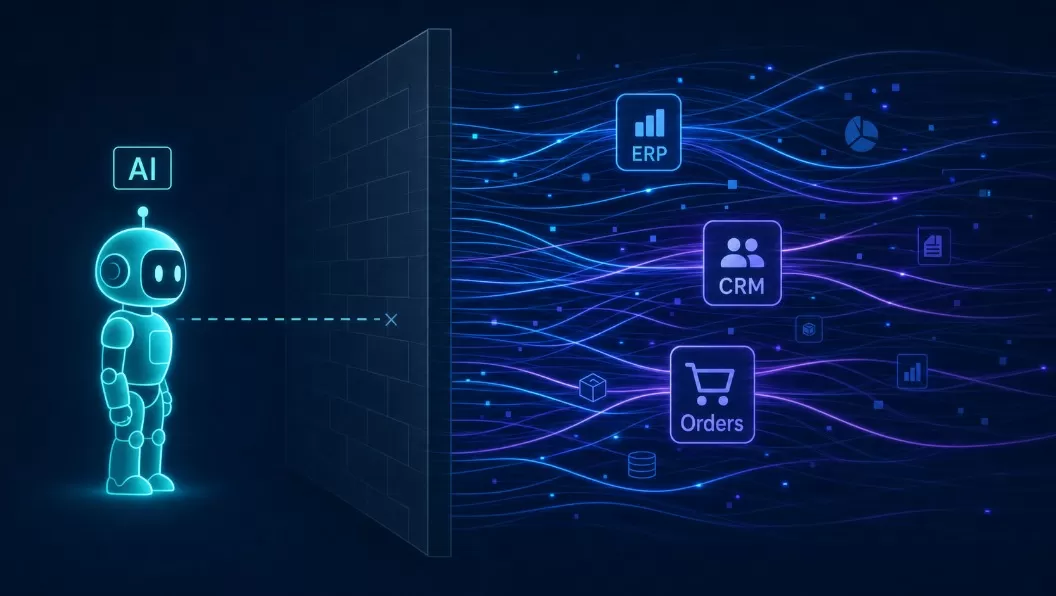
Not because the AI wasn't smart enough. Because the AI was cut off from the business. It stood outside the enterprise system, watching data stream past the windows and doors, unable to get in.
Consider another scene. An Italian restaurant chain operator has a long wish list: invoice photo upload with automatic data extraction, independent financial management and permission tiers across locations, WhatsApp bulk messaging without triggering bans, positive reviews automatically syncing to Google Maps. The local industry's digital maturity is low—still dependent on manual bookkeeping and experience-driven management. What this operator needs isn't a smarter chatbot. It's a solution that runs the entire road: from accounting to analysis, from reservations to customer service, from private engagement to public reputation.
Both scenarios point to the same thing: AI can hold a conversation, but the moment it meets a real business workflow, it falls silent. Not from lack of capability, but because it doesn't understand your business and can't plug into your systems.
The problem has never been "AI isn't good enough." It's "AI is good enough, but it has nothing to do with me."
Results, Not Toolkits
Enterprise demand for AI deployment is converging globally—they want results, not toolkits. The only difference is pace: some markets are still trying to assemble things themselves; others have given up and say, just build the solution for me, I'll pay.
Gartner predicts that 40% of enterprise applications will feature task-specific AI agents by 2026, up from less than 5% in 2025. Source: Gartner, August 2025
When an enterprise says "I need an AI solution," what they're really saying is: I need someone who understands my business processes, embeds AI into them, keeps it running, and has my back when something goes wrong.
The shift from selling products to selling solutions isn't a marketing strategy adjustment. It's a response to the customer's actual predicament.
What the Latest GPTBots Upgrade Delivers
GPTBots has recently rolled out a major upgrade, with core changes centered around three key areas:
- Knowledge Base Overhaul: Introducing knowledge graphs, hybrid vector-and-graph retrieval, precise metadata filtering, and ACL access controls. This evolves agents from merely "searching documents" to truly "understanding the business."
- Advanced Workflow Execution: Featuring an Agent Loop Engine, direct integration of agent form data with the EngageLab LiveDesk Widget, a multi-dimensional memory system, and A2A protocols for sub-agent collaboration. This transitions agents from just "answering questions" to "executing tasks."
- Reinforced Enterprise Governance: Equipped with runtime security, audit logging, and safety guardrails. This takes agents from being "demo-capable" to fully "production-ready."
Three pillars, one singular goal: Empowering agents to genuinely understand your business, operate securely within real-world workflows, and deliver measurable results.
Knowledge Base: From Searching Documents to True Business Comprehension
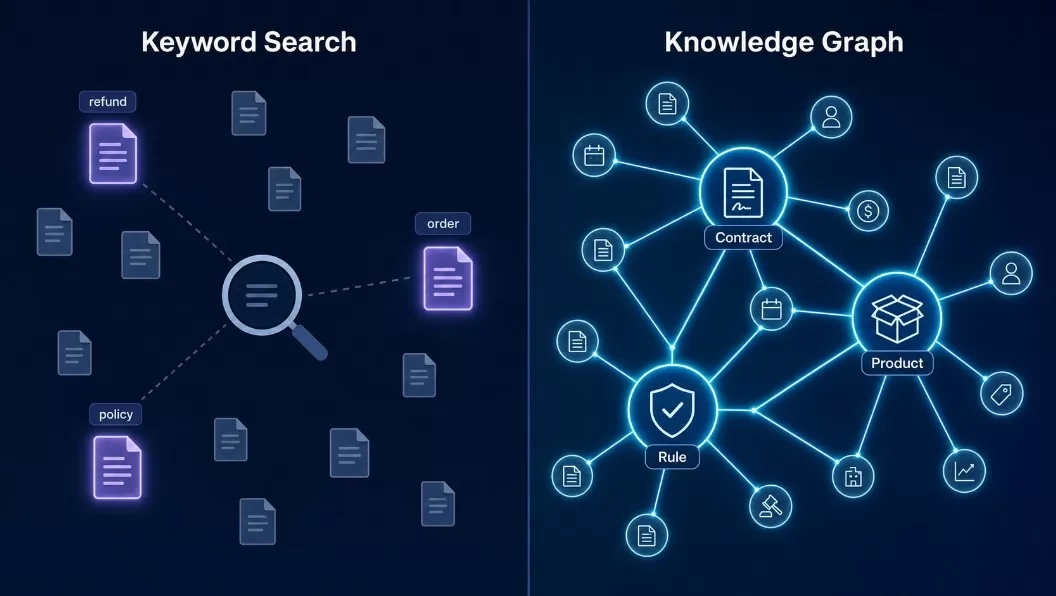
Historically, AI agents queried knowledge bases much like traditional search engines: matching keywords and ranking by hit frequency. Knowledge graphs bridge these relational gaps. Powered by our newly upgraded hybrid vector and graph retrieval mechanism, an agent no longer merely "fetches a relevant document." It now understands exactly which contracts are tied to the customer, which products are included in those contracts, and which specific rules apply.
From Understanding to Execution: Embedding Agents into Real Business Workflows
Agent-driven form collection now integrates seamlessly with the EngageLab LiveDesk Widget. Customers can fill out and submit forms directly within the chat, and the agent processes them instantly—eliminating the "chat with AI, wait for a human to do the actual work" bottleneck.
Our Three-Dimensional Memory ensures the agent knows who the user is, their historical context, and the exact next steps. We've also introduced Key Event Extraction: instead of passively recording chat transcripts, the agent actively identifies high-value actions.
"Enterprises worldwide are shifting from buying tools to buying outcomes. Customers don't need another toolbox. They need a solution that understands their business, embeds into their workflows, and has their back when something goes wrong." — Chris Lo, Founder and CEO of GPTBots.ai
Deloitte's 2026 State of AI in the Enterprise report shows that 74% of organizations plan to deploy agentic AI within two years, yet only 21% currently possess a mature governance model. Source: Deloitte, 2026
A Unified Customer Lifecycle Pipeline
Acquisition → Verification → Engagement → Support → Retention → Growth.
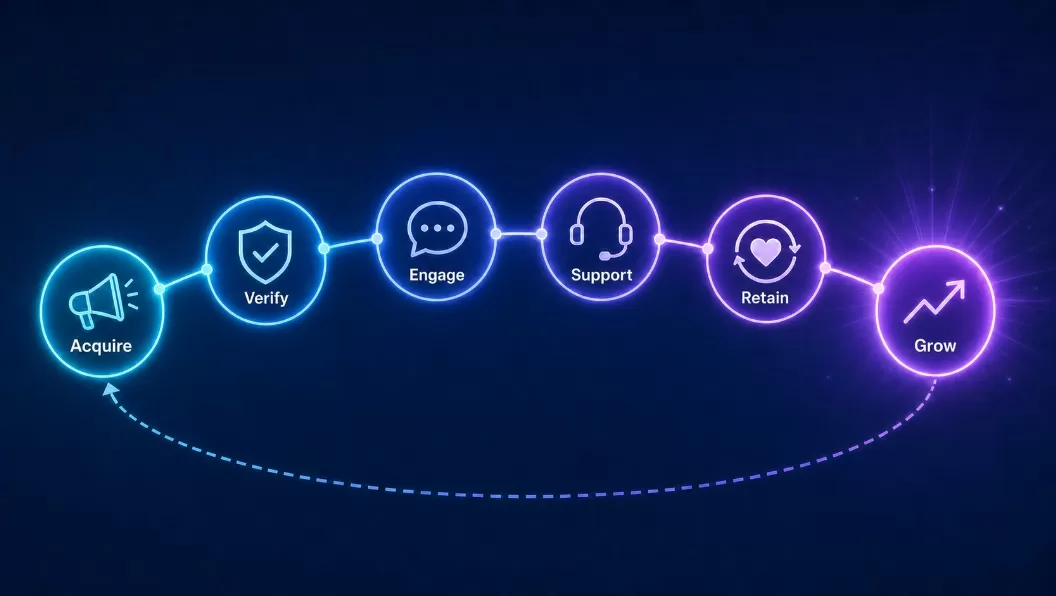
EngageLab closes the loop on customer interaction—powering everything from identity verification, cross-channel outreach, and marketing automation, all the way to intelligent routing and seamless human handoff. Meanwhile, GPTBots ensures the critical nodes within this pipeline are actively executed by AI.
A Closing Reflection
The real battlefield for AI agents isn't about who can spin up a basic chatbot the fastest. It's about who can securely embed agents into real-world enterprise workflows. Every upgrade we ship closes that gap.